Zone Crawls
"fixing" what to me feels like the biggest issue with Pointcrawls. An alternative abstraction for overland travel in your elfgames.
5/12/20266 min read
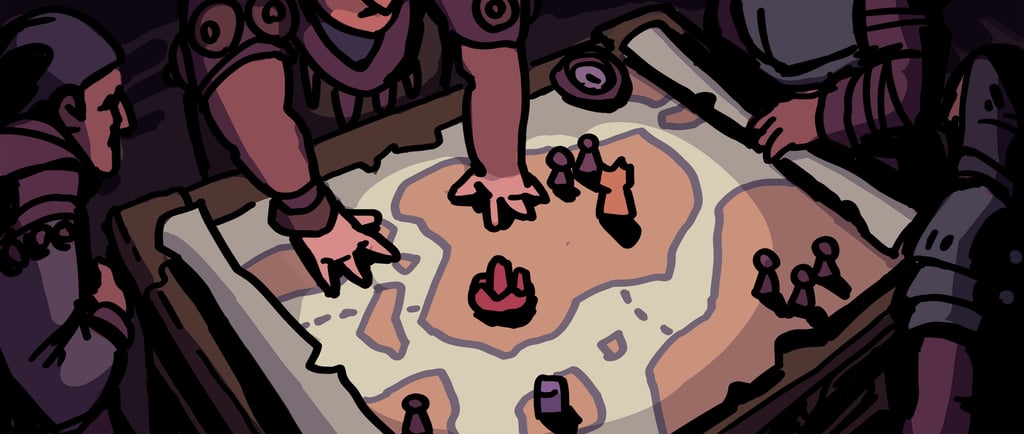
Solving overland travel seems to be a perennial obsession for the RPG blogosphere. There's always something imperfect with the way we abstract vast distances and simulate journeys. Always something missing in the procedure or the actual visual abstraction we put in front of our players.
Don't worry dear reader and fellow blog enthusiast, I won't be solving all of your problems here today, but rather proposing what I've found to be an attractive compromise for the system I'm currently writing.
I was set on this track by Mr. Prismatic Wastelands Blogwagon Roundup, where the paragons of our community came together to muse about Maps as a broad topic. There are a ton of gems in there, but it mostly got me thinking of my own unsatisfactory Overland procedure and map.
It was essentially a pointcrawl laid over a Hexmap, not unlike the way The One Ring handles its journey procedure. For those unfamiliar, that system requires the players select a destination in advance of their travels, plot a route and resolve encounter rolls to determine what complications/discoveries happen along the way.
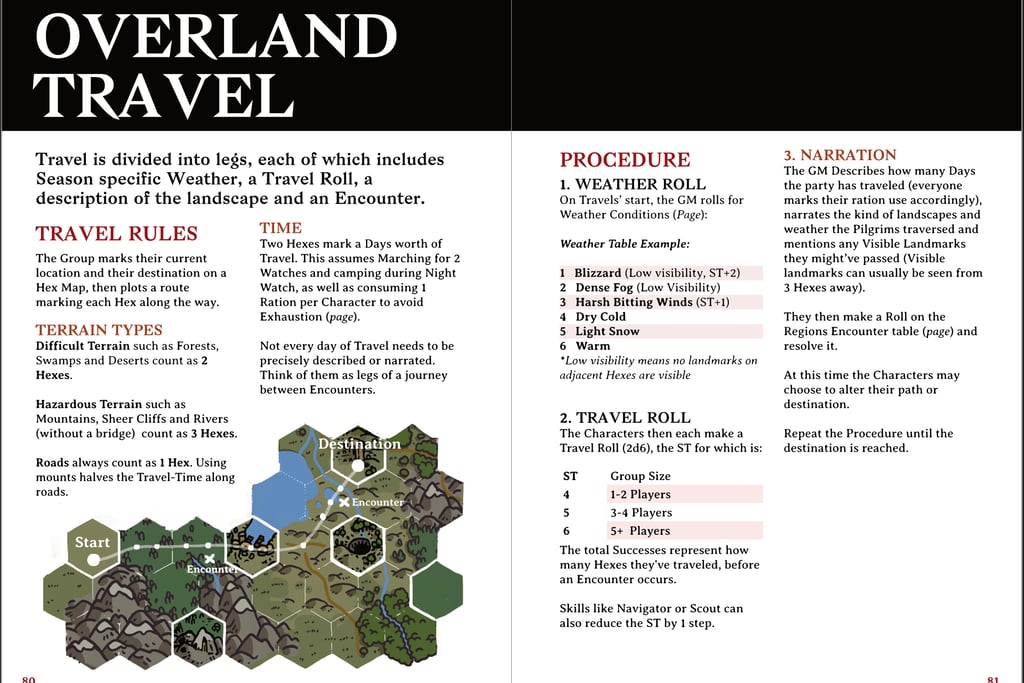
This is a screenshot of my Travel Procedure before I went in with a hatchet.
To explain why my new system behaves differently, I need to describe what this original system was trying to solve:
My Problem with Hexcrawls
Hexcrawls are the default solution for most OSR adjacent games for a reason. They map distances very well, include plenty of resolution for different terrain types and navigation choices and most importantly allow the Characters to go anywhere on the map they can point to, provided they have the resources to get there which is another element that's well served by the humble hexcrawl.
My problem with them is that in practice, most of the detail and accuracy they provide don't ultimately make for very satisfying travel montages. The journey is hampered by constant interruptions with random encounter rolls for every Hex, most of which don't really lead to an encounter.
Furthermore the turn-based nature, or the Crawling part of it, don't really provide an elegant platform for describing the journey as the Characters move from Hex to Hex. All the landscape features and landmarks are easily accessible as information, but narrating them for each turn slows the game downs significantly.
Now I know there are tons of ways to mitigate a lot of these problems, but adding more procedure on top of Hexcrawls to me always just ends up feeling a bit more fiddly than I prefer. I like simplicity when it comes to Overland Travel, I like abstraction. What I want is to be able to narrate the journey for my Players as vividly as I can manage and present some encounters and interesting choices along the way. Which brings me to:
My Problem with Pointcrawls
You might be thinking: "Pointcrawls solve literally every one of your problems, why is this blog post so long, use pointcrawls and shut up."
And yes dear reader I have considered just using pointcrawls many times. They tick so many of my boxes. They're nice and abstract, require minimal procedural fiddling, simulate a linear journey really well and provide plenty of breathing room for evocative travel descriptions between any encounters you want to roll along the way.
They're extremely appealing and seeing this Blog Bookclub by The Cauldron, where they re-surface one of the first suggestions of using Pointcrawls in RPGs (and how elegant that first swing at it was already), gave me the itch to pick at my Travel system again.
My one problem with Pointcrawls however, is I have a hard time visualizing exploration or "going off the beaten path" in this system. That's not to say it can't be done, but getting lost in the wilderness looking for something not yet mapped by a road never quite felt right here.
The Solution
I stumbled on what I find to be the perfect middle ground to all of this by referencing my rules for movement in Combat which gets divided into Zones.
Now unlike a lot of other systems where these "Zones" get abstracted into distance bands, I propose the GM divide the space into logical sections based on its characteristics (elevation is a zone, a central space is a zone, sections near entrances can be a Zone etc). This divides the space into natural looking chunks and provides units of measurement for movement without the fiddlines or slowness of a grid and avoiding the systemic abstraction of bands (ICRPG essentially does the same using index cards, I didn't invent any of this).
But this got me thinking, perhaps there's a way to abstract overland travel in exactly the same way. It would mean all the spacial relations in my system get mirrored, which reduces cognitive load and provides a touchstone when learning the different parts of a game (which I'm obsessed with and will probably write about sometime in the future).
It turned out all the pieces just fell into place as soon as I took a map and divided it into Zones (Calling them regions might be a bit more descriptive but I didn't want the cultural implication).
Here's how it works:
Divide into Zones
The map gets divided into a few Zones based on geographic features. How much you want to divide and how granular you want to get is up to you, I imagine this will withstand quite a bit of fragmentation if you want the resolution.Place Points of Interest
You place your Dungeons, Hubs, Landmarks etc. Much like you would in a Pointcrawl, but the nodes aren't connected via lines representing routes.
Assign Distances
Distances are heavily abstracted here. Moving between any two Points of Interest in a Zone takes 1 Watch. Traveling between two Zones takes a Day, unless the zone contains difficult terrain like mountains, marshes etc. in which case it can take several days.
Borders between Zones can also function as Barriers, Impassable without hidden information (Lifted this from Mythic Bastionland) or impairing travel or incurring extra cost on resources in some other way.Add Detail
Each Zone should have a write-up describing some landscape features, Landmarks and relevant Faction activity for the GM. They also function as neat little containers for random Encounter Tables that can be filled with Zone-Specific goings-on and updated between games. This would be a great place to use Hexframes as described by A shrike for my dreams.
Laying out a map like this allows for easy to track distances between any location, a fragmentation far less granular than Hexes that speeds up the travel procedure and groups areas of the map together into logical chunks that make describing the terrain traversed simple and provide a container for encounters that fit the area perfectly.
It also creates spaces for the Characters to explore or get lost in. They might arrive to a new Zone, the GM describes the landscape features, at which point they decide to search the area. A simple procedure could allow them to discover a hidden Point of Interest or be faced with an encounter. All while spending time, using resources etc.
This solves most of my quibbles with the other two more established systems, with just the right level of abstraction for my liking.
Obviously I can tell this solution won't be to everyone's liking. I suspect the abstraction in distance between two points will be a bit too much for some people to handle. It sacrifices fidelity in spacial relationships for ease of use much like a Pointcrawl, with the added benefit of allowing easy exploration procedures and systems for getting lost.
I asked around and found that Dwiz of A Knight at the Opera fame also prefers this kind of "crawl" and wrote on using them for urban exploration. Here's another one from D4 Caltrops.
It seems people really gravitate to fragmenting a city like this because districts or boroughs are such a natural way to section them. I think there's no reason not to extend the benefits to your Overland Map as well!
PS: I've also since been made aware of this excellent post by Marcia B. on what she ended up calling Fluxcrawls as a nod to Nick Whelan's Flux Space. This is pretty close to what I end up proposing here with some minor design aesthetic differences. There's probably something to this seeing as a bunch of people smarter than myself are arriving at similar solutions.
If you found any of this interesting or amusing, please consider subscribing to my Newsletter. I won't ever spam you, but you will get the vert rare notification when I feel like I have something significant to share.
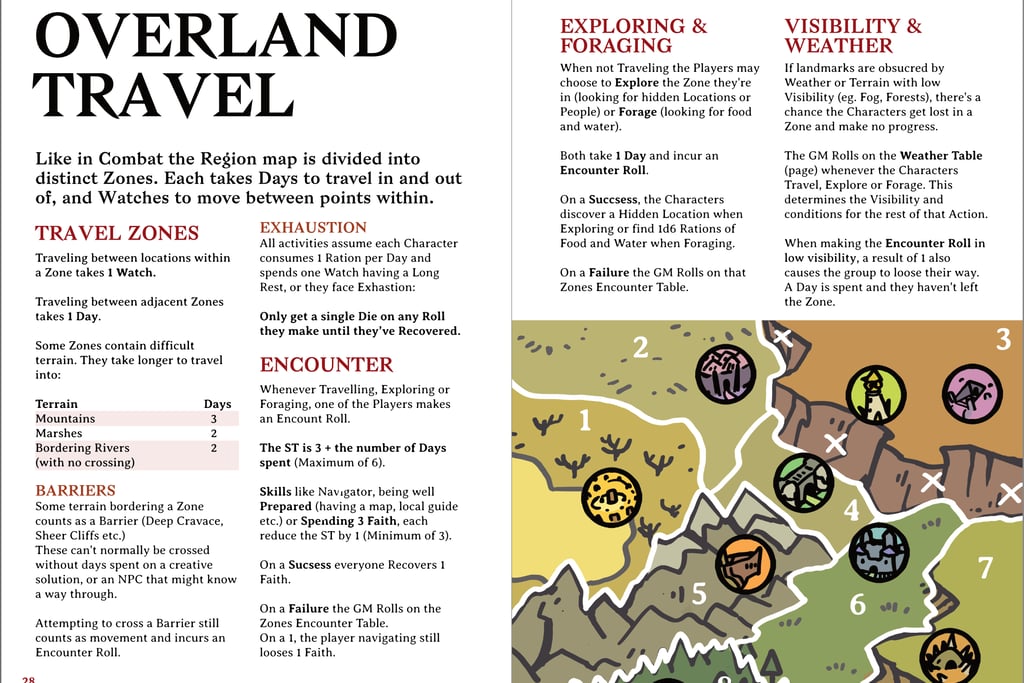
Here's a spred from my game describing how the Characters can interact with the Zones (WIP)
Feel free to get in touch if you like my work. I'm happy to answer any questions or help where I can.
Contact


Socials